


How coolant filter media affects part surface quality
You invest in expensive abrasive belts and premium coolants, yet micro-scratches still appear on your parts? The problem often lies in the filtration system. Reusing dirty coolant is like trying to wash a mirror with a muddy cloth.
Using dirty coolant is like trying to clean crystal with a dirty rag. Let’s take a look at how filter cloths can save your production.
How dirty coolant ruins your finish:
-
Surface defects: Recirculated metal particles act as rogue abrasives, creating unwanted scratches.
-
Machine wear: Fine metal dust acts as an abrasive paste, grinding down your expensive pumps and nozzles.
-
Abrasive clogging: Instead of flushing away debris, dirty coolant helps it "load" the belt, significantly reducing tool life.
Choosing the right media:
-
Polyester (PES): Strong and tear-resistant, the best all-rounder.
-
Polypropylene (PP): Excellent chemical resistance for aggressive fluids.
-
Viscose: High filtration precision but lower tensile strength.
Clean coolant — flawless parts!
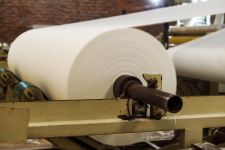
Ready to eliminate scratches and stop wasting money on frequent coolant changes? Stark Abrasive provides high-quality non-woven filter media (20 to 100 g/m²) in rolls tailored to your machine type.
Give your equipment the "clean breath" it deserves!
📞 Call us: +38 (050) 222-00-83
Characteristic:
Fiber: viscose
Mass per unit area/specific gravity: g/m2 50
Thickness: mm 0.29
Tensile strength: N/5 cm 130 – 25
Stretching: % 10 - 15
Air permeability: l/(m2·s) 2.700
Characteristic:
Fiber: polyester
Mass per unit area/specific gravity: g/m2 30
Thickness: mm 0.20
Tensile strength: N/5 cm 45 – 25
Stretching: % 20 - 35
Air permeability: l/(m2·s) 6.200
Characteristic:
Fiber: viscose
Mass per unit area/specific gravity: g/m2 40
Thickness: mm 0.25
Tensile strength: N/5 cm 100 – 17
Stretching: % 10 - 15
Air permeability: l/(m2·s) 3.500
Characteristic:
Fiber: viscose
Mass per unit area/specific gravity: g/m2 60
Thickness: mm 0.30
Tensile strength: N/5 cm 140 – 30
Stretching: % 10 - 15
Air permeability: l/(m2·s) 2.500


