


Abrasive materials: your guide to selection
- Classification of abrasive materials by type of raw material
- Classification of Abrasive Materials by Raw Material Type
- Types of abrasive materials by purpose
- 1. Abrasives for metal
- 2. Abrasives for wood
- 3. Abrasives for glass and ceramics
- How to choose the right abrasives?
- What abrasive materials are best used in production?
Abrasives play a key role in metalworking, woodworking, construction and repair. They are used for grinding, polishing, surface preparation before painting or varnishing. The quality of the finish, the durability of the tool and the final result depend on choosing the right abrasive.
How to choose the perfect abrasivefor your tasks? Let's look at the types of abrasives and their main characteristics.
Classification of abrasive materials by type of raw material
Abrasives can be divided into natural (natural) and synthetic. Today, the industry mostly uses artificial abrasives because they have stable characteristics, higher wear resistance, and are better suited to different types of surfaces. Here are the main types of abrasive materials and their applications: Type of abrasive Material manufacturing
Ось переклад таблиці англійською мовою:
Classification of Abrasive Materials by Raw Material Type
| Abrasive Type | Material Composition | Application | Advantages |
|---|---|---|---|
| Aluminum Oxide (Al₂O₃) | Synthetic corundum | Metal, wood, plastic | Durable, long-lasting, versatile, suitable for coarse and fine grinding |
| Silicon Carbide (SiC) | Silicon + carbon | Glass, ceramics, cast iron, hard alloys | Very hard, heat-resistant, rapid material removal |
| Zirconia Alumina (ZrO₂) | Zirconium and aluminum oxide blend | Steel, stainless steel, ferrous metals | High aggressiveness, self-sharpening, durable for heavy-duty grinding |
| Ceramic Abrasive | Synthetic ceramic | Precision metal grinding, fine finishing | High efficiency, even wear, long service life |
| Diamond Abrasive | Polycrystalline diamond | Tungsten carbide, ceramics, stone | Highest hardness, longevity, minimal heat transfer |
| Cubic Boron Nitride (CBN) | Boron and nitrogen compounds | Hardened steels, heat-treated materials | High thermal resistance, excellent for precision grinding |
Types of abrasive materials by purpose
Abrasives are used invarious areas, from metal and wood processing to glass, ceramics and plastic. The choice depends on the hardness of the material, the type of work and the final effect that needs to be obtained.
1. Abrasives for metal
Metal requires abrasives with high wear resistance and heat resistance. The best materials for metal processing:
✔ Ceramic abrasives – for finish grinding
✔ Zirconium belts – for rough metal removal
✔ Aluminum oxide – for universal use
2. Abrasives for wood
For wood processing, it is important to choose thecorrect grain:
✔ P40–P80 – for removing paint, varnish or rough leveling
✔ P100–P180 – for intermediate grinding before painting
✔ P200+ – for final polishing
3. Abrasives for glass and ceramics
For working with glass and ceramics, silicon carbide or diamond abrasives are used, which do not leave scratches and provide precise processing.
How to choose the right abrasives?
To choose the optimal abrasive material, you need to consider several factors:
✔ Surface type – metal, wood, glass, plastic or ceramics.
✔ Grain level – the higher the number, the finer the particles (rough grinding = low grit, polishing = high grit).
✔ Work intensity – if grinding is carried out intensively, it is better to choose ceramic or zirconium abrasives, which have high wear resistance.
What abrasive materials are best used in production?
For industrial needs, the most modern abrasives are used, which provide high processing speed and long service life.
🔹 Aluminum oxide – universal choice for woodworking and medium-hard metals.
🔹 Zirconium abrasives – ideal for heavy metals and high loads.
🔹 Ceramic abrasives – are great for precision grinding and high-quality finishing polishing. 🔹 Diamond abrasives – are used for processing superhard materials, such as ceramics and composite alloys.
🔹 Abrasive materials are an important element in production, construction and repair.
🔹 The right choice of abrasive
✅ This table accurately reflects modern standards for abrasive materials. Let me know if you need any modifications! 😊
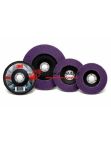
3M™ Flap Disc 769F – is our durable, high-performance abrasive flap disc with precision-shaped grains from 3M™ Precision-Shaped Grain and durable polyester base.
3M™ Flap Disc 769F – convenient, strong, efficient and universal petal disc. Our discs are coated with 3M™ Precision-Shaped and proven to be more effective than traditional zirconium corundum petal discs. This abrasive is constantly breaking down to form sharp particles that cleanly cut metal, unlike traditional abrasives that tend to plow through the substrate. This breaking down into particles, together with the destruction of individual petals to release fresh layers of mineral, ensures a high grinding speed that is stable throughout the life of the disc. Polyester base additionally extends durability. Together with the high adhesion, this makes the discs an ideal choice for high-pressure jobs such as beveling, grinding welds and deburring edges. In addition, they create clean surfaces, which makes them indispensable for smoothing and surface preparation. In many cases, 3M™ Flap Disc 769F provides sanding and finishing without changing the abrasive tool. This is possible because under normal conditions the 769F disc finish is one step thinner than a fiber disc of the same grade. Although the fiber disc grinds faster, this petal disc simplifies the process flow, eliminating the need to change tools, which saves time and increases productivity. An ideal choice for processing carbon steel, stainless steel and other alloys sensitive to high temperatures.
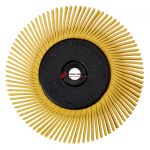
Scotch-Brite radial brushes™ BB-ZB are usually used on stationary equipment, for example, on grinding and grinding machines with manual feed of the part to the machine or on pass-through machines with automatic feed of the part.
To remove paint, stains , adhesives, weld burns, rust, heavy oxides and surface contamination from various metals, use Scotch Brite™ Radial Bristle Brush. Brushes use our proprietary 3M™ Ceramic Abrasive Grain, including aluminum oxide, with molded, flexible yet firm bristles that provide more surface contact than brushes. We have increased the life compared to wire and other abrasive discs. Abrasives wear down gradually over the life of the product, and they work well on a variety of metals, including aluminum, brass, bronze, carbon steel, cast iron, stainless steel, and more. Ceramic abrasive grain is a ceramic mineral manufactured using the 3M process to increase grain strength and hardness. Discs Scotch Brite™ uses aluminum oxide mixed with a ceramic abrasive grain, and the result is one of the hardest, longest-lasting minerals. Ceramic abrasives are designed to cut and machine quickly under intense heat and stress. Ceramic abrasive grain is superior to aluminum oxide abrasives in terms of speed and durability. It can be used for industrial grinding and finishing. Scotch Brite Industrial Abrasives are unique surface preparation products with abrasives embedded in non-woven nylon or synthetic fibers. Combining abrasives with fibers creates an abrasive system that provides consistent results throughout the life of the product.
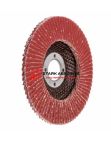
3M petal discs™ Cubitron™ II 967A are designed for grinding and finishing in one step and perform a larger amount of work in the same time. The exceptional capabilities of the precision-shaped ceramic grain of 3M™ in petal grinding discs. Petal grinding discs 3M™ Cubitron™ II work faster and require less pressure, helping to reduce operator stress on the most difficult operations, including grinding operations, weld removal, deburring and more.
The secret to high efficiency flap discs 3M™ Cubitron™ II 967A consists of 3M™ precision shaped ceramic grain. Triangular grains are oriented perpendicular to the base, act as cutters, easily cutting through metal, and are constantly self-sharpening as the microparticles are chipped during the grinding process. As a result, Cubitron™ II 967A grinds quickly and without overheating and continues to work after ordinary discs have exhausted their resource and need to be replaced.
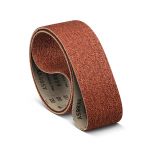
It is intended for work with medium and high pressure pressure, for example, for cylindrical grinding of pistons, cylinders and rollers.


